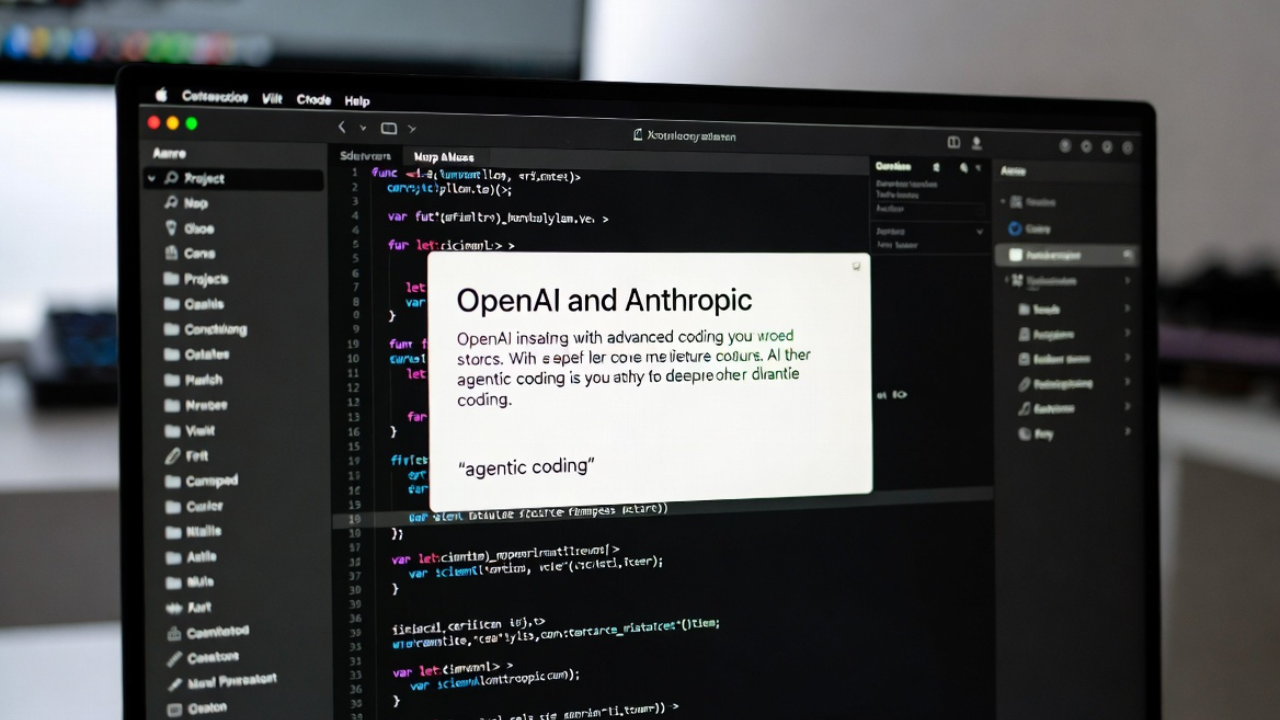
In a major leap forward for software development, Apple has unveiled a groundbreaking update to its flagship integrated development environment (IDE), Xcode 26.3, which transforms how developers build apps for its expansive ecosystem.
With richer integrations of OpenAI’s Codex and Anthropic’s Claude Agent, this update pushes Xcode beyond assisted code completion into true agentic coding where intelligent AI agents can autonomously plan, write, test, and refine code right inside the IDE itself.
This blog dives deep into Apple’s strategic push, the implications for developers worldwide, and what this means for the future of coding workflows.
What Is Agentic Coding?
Before exploring Xcode’s update, it’s important to understand what “agentic coding” means.
Traditionally, AI tools integrated into IDEs have offered autocomplete, suggestions, or contextual help when prompted by a developer. While valuable, these features require active participation from the user at every step.
Agentic coding refers to AI systems that take goals from developers and independently execute multi-step tasks, much like a junior engineer might. Instead of merely suggesting snippets, an agentic system can:
- Analyze the structure of an entire project
- Plan a sequence of coding operations toward a goal
- Write, test, and validate code autonomously
- Iterate when bugs or errors are detected
This marks a fundamental shift—developers are no longer limited to reactive AI help. Instead, they gain AI collaborators that can proactively transform user goals into working software.
Xcode 26.3: Apple’s Big Step into the Future
1. Release Candidate Now Available
Apple announced the release candidate of Xcode 26.3, making this major update accessible immediately to developers in the Apple Developer Program and soon through the App Store.
This release candidate signals that the feature is nearly ready for general use but may be fine-tuned before a full public launch.
2. Deep Integrations With OpenAI Codex and Anthropic Claude Agent
Xcode 26.3 introduces built-in support for some of the most capable coding agents available today:
- OpenAI’s Codex – an advanced agent designed to generate, edit, and reason about code with high precision.
- Anthropic’s Claude Agent – a powerful AI capable of planning and long-running tasks that understands project context and can work autonomously over many steps.
These integrations go far beyond simple plugins. They allow agents to access core Xcode features such as:
- Project structure & metadata
- Apple developer documentation
- Build tools and previews
- Testing frameworks
Once connected, agents can interact with these systems to perform real actions on behalf of developers.
How Agentic Coding Works in Xcode?
Here’s a practical picture of how agentic coding functions within Xcode:
1. Setting the Goal
Developers provide a goal using natural language for example: “Add a login screen with biometric authentication and server-side error handling.” Once the command is submitted, the agent begins its process.
2. Project Exploration
Instead of staring at a limited context window like classic autocomplete, agents can:
- Traverse the entire codebase
- Understand dependencies and API usage
- Identify where work needs to happen
This whole-project analysis gives agentic systems dramatically more awareness than earlier LLM IDE tools.
3. Intelligent Planning
Before writing any code, an agent creates a task plan composed of multiple steps like setting up UI components, implementing logic, and wiring tests. A planning phase reduces errors and prevents the agent from writing code blindly.
4. Execution and Autonomous Coding
The agent:
- Writes new files or modifies existing ones
- Runs builds to check for compiler issues
- Generates previews to visually validate UI
- Iterates until the build is functional and meets test criteria
This is true agentic autonomy, where AI does the heavy lifting instead of just offering suggestions.
Model Context Protocol (MCP): The Open Standard Advantage
A key part of Apple’s strategy is support for the Model Context Protocol (MCP) an open, extensible standard that allows Xcode to communicate with any AI system capable of conforming to it.
This means:
- Developers aren’t limited to only Apple-approved AI services
- New agentic tools can plug into Xcode if they support MCP
- CLI integrations and external scripts can connect to Xcode’s capabilities
MCP bridges the gap between Xcode’s internal mechanics and external AI brains unlocking flexibility for the future.
What This Means for Developers
Agentic coding in Xcode isn’t just a flashy headline it offers real, tangible benefits:
1. Streamlined Workflow
Developers spend less time writing boilerplate code, fixing errors, or jumping between tools. Instead, agents can handle:
- Code generation
- Project refactoring
- Build verification
- Preliminary testing
This condenses hours of work into minutes.
2. Faster Prototyping
For startups and indie developers, agentic coding accelerates idea validation. You feed a feature goal into Xcode, and the AI starts shaping a prototype with minimal manual coding.
3. Learning Tool for New Developers
Especially for beginners, agentic coding exposes you to real examples of how real code should be written. The ability to visualize decisions and see project decisions explained can flatten the learning curve significantly.
4. Multi-Agent Choice
Developers can choose which agent suits the task OpenAI’s Codex for rapid generative capability or Anthropic’s Claude Agent for deep contextual reasoning. This flexibility means you’re not locked into a single provider or workflow.
Challenges and Considerations
While the excitement is palpable, there are factors developers should be mindful of:
1. Efficiency and Cost
Integrating AI services like OpenAI and Anthropic often involves API usage fees. Developers should monitor usage and optimize prompts to avoid excessive costs.
2. Transparency and Control
Projects modified autonomously need a clear audit trail. Xcode provides task transcripts, but developers should always review and understand changes made by AI.
3. Quality and Trust
AI agents aren’t perfect. While they can handle many tasks, edge cases and deeply complex architecture decisions still benefit from human oversight. Apple’s tools aim to augment developer power not replace it entirely.
The Future of IDEs and Agentic Coding
Apple’s push with Xcode 26.3 reflects broader industry trends:
- AI agents are becoming central collaborators
- IDEs are evolving into autonomous platforms
- Developers will increasingly work with AI rather than against it
Agentic coding might soon become a standard expectation in IDEs across platforms not just for Apple developers.
This opens possibilities like:
- Cross-IDE agentic workflows
- Hybrid local/cloud AI development models
- Autonomous QA bots
As these tools mature, we may see a paradigm where the developer’s role evolves from typing code to guiding and supervising AI collaborators.
A Paradigm Shift for Developers
Apple’s integration of OpenAI’s Codex and Anthropic’s Claude Agent into Xcode 26.3 marks a milestone in developer tooling. By embracing agentic coding, Apple isn’t just improving an IDE it’s redefining what development workflows look like in the age of advanced AI.
Whether you’re a solo indie developer or part of a large enterprise team, these changes invite you to rethink how you build applications. The code you write tomorrow may be collaboratively composed with humans and AI working side by side toward innovation.
At Famups, we help individuals and organizations unlock the full potential of modern social media growth (followers, likes, views) and AI-driven workflows.


One thought on “Xcode Moves Into Agentic Coding With Deeper OpenAI and Anthropic Integrations”
Comments are closed.