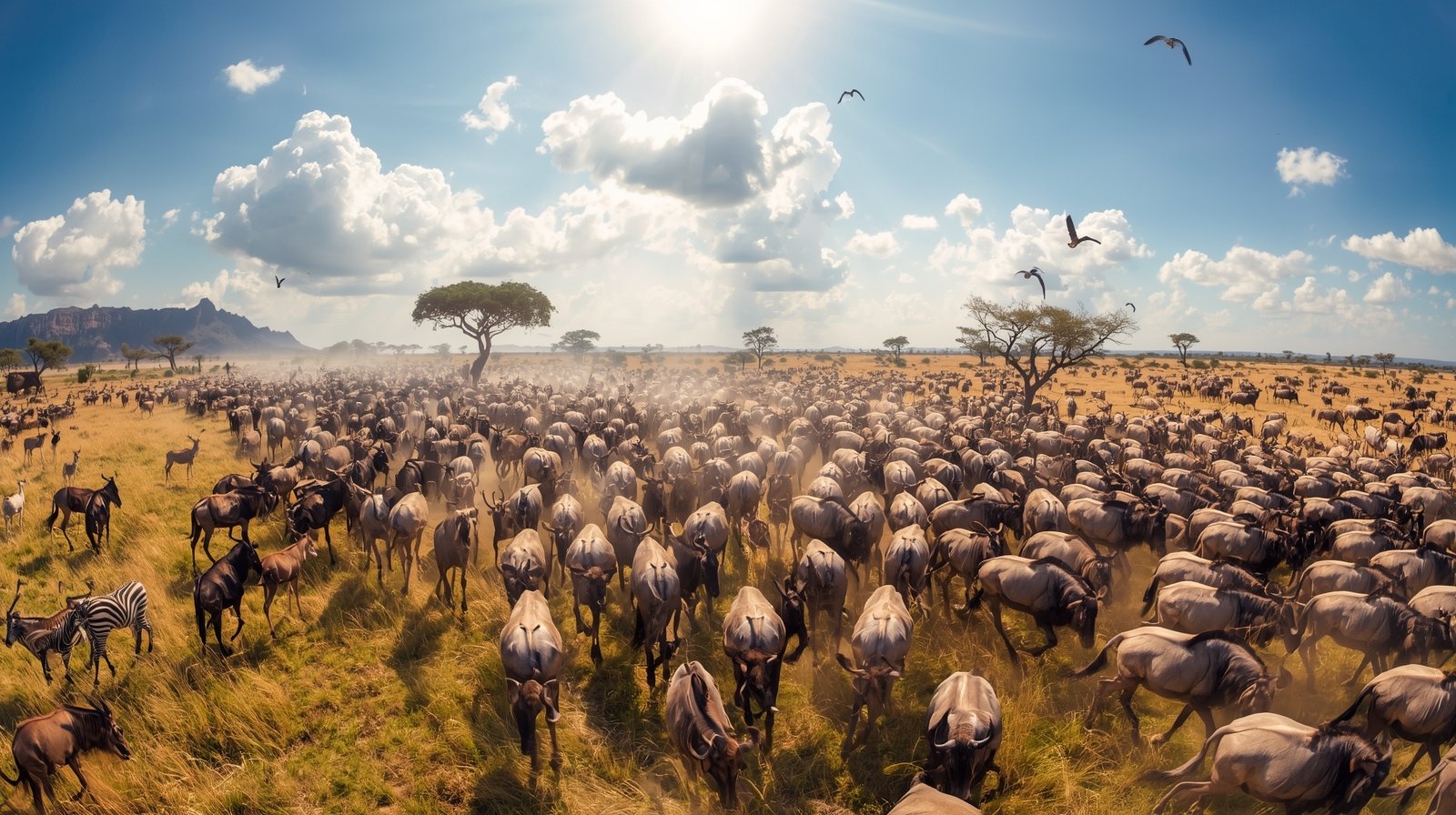
The Serengeti Great Migration is a constant ecological flow and not a one-time occasion. Every year, more than one million wildebeest, along with gazelles and zebras, move across the Serengeti ecosystem of Tanzania as well as into Kenya. If you look closely at the Serengeti Great Migration, you will realize it isn’t driven solely by nature but by environmental conditions. Therefore, let’s learn why animals take part in this process and how it impacts the whole region.
The Rainfall Patterns are the Primary Trigger
The southern Serengeti is likely to receive brief rainfalls at the end of the year, and this results in dramatic growth of nutrient-rich grass. The new vegetation becomes a source of reproduction and food to the animals, and this attracts huge herds of animals to the grass.
How rainfall governs migration movement:
- Seasonal rainfall cycles.
- Grass regeneration zones.
- Nutrient availability shifts.
- Regional climate variation.
- Predictable weather patterns.
- Survival-driven movement.
Herds of animals follow these trends because remaining within a single area would mean being in the midst of depleted pastures and a lack of access to water. This is why the Serengeti Great Migration exists: animals are able to respond specifically to rain cycles that change across different regions instead of merely across time.
Qualities of Grass and Dietary Requirements
The wildebeest need short grass that has significant mineral content to ensure the level of energy and health of their reproductive system. If the grass matures or dries down, the grass loses nutrients and therefore isn’t suitable for grazing on a regular basis.
The importance of grazing quality:
- Short grass preference.
- Mineral-rich forage.
- Species grazing roles.
- Energy maintenance needs.
- Feeding hierarchy balance.
- Vegetation renewal process.
This can improve conditions for other species to graze. When you look at this interplay, it is clear that the Serengeti Great Migration is not an unorganized movement, but rather an ordered process, affected by specialization in diet.
Access to Water and Daily Survival Essentials
In the dry seasons, small water sources are lost, forcing animals to migrate towards permanent water sources and wetlands. The large rivers are essential points of crossing on the migration routes.
How to connect migration routes to water access:
- Daily hydration needs.
- Seasonal water scarcity.
- Permanent river reliance.
- Natural movement corridors.
- Survival-based decisions.
- Geographic constraint adaptation.
Another risk is also the situation where the only method of accessing water or food involves having to cross a river. This explains why the Serengeti Great Migration has persisted, since animals should have access to water to survive.
Calving Season and Reproductive Strategy
Most of the calves are born within the shortest time. This is a synchronized birthing method, which increases the survival chances as the predators are overwhelmed in large numbers.
How reproduction aligns with migration:
- Synchronized birthing period.
- Predator dilution effect.
- Nutritional grass support.
- Calf survival increases.
- Maternal health stability.
- Population continuity strategy.
Green grass assists lactating cows and makes sure that the calf is adequately nourished during the most critical period of their lives. Considering this process, it becomes obvious that the Serengeti Great Migration aids in population stability by means of accurate timing.
Ecological Balance and Predators
The migration is followed by predators because they have a consistent opportunity to hunt; however, they are not able to control the movements themselves. Predators all belong to the same ecosystem and depend on migrations to sustain their populations.
How predators fit into the system:
- Natural population control.
- Weak individual removal.
- Predator prey balance.
- Ecosystem health maintenance.
- Sustainable species interaction.
- Evolutionary stability process.
In terms of ecology, predation is a way to remove weaker animals and aids in maintaining the health of herds. If you consider the scientific perspective, it is a balanced system where both predators and prey are dependent on predictable patterns of movement.
Learning and Inherited Routes of Animals
The migration routes of the Serengeti aren’t new. They have been in existence for centuries and are handed down over generations. The young animals are taught where to go through the herd.
How evolutionary knowledge sustains migration:
- Generational route memory.
- Learned movement behavior.
- Herd guided navigation.
- Historical migration paths.
- Environmental pattern recognition.
- Collective movement intelligence.
This behavior is learned and explains why patterns of migration are consistent, regardless of the individual animal’s behavior. This is because the Serengeti Great Migration reflects long-term environmental memory.
The Importance of an Unfragmented Ecosystem
One of the reasons this migration occurs is due to the freedom in this Serengeti ecosystem. Huge protected areas allow animals to freely move around with no permanent boundaries.
Why ecosystem continuity matters:
- Open migration corridors.
- Habitat connectivity importance.
- Natural land regeneration.
- Grazing pressure balance.
The farming animals fertilize the soil and ensure the growth of new plants. Looking at the entire ecosystem, one will realize that the Serengeti Great Migration is beneficial to the wildlife and the terrain.
Timeframes for Viewing Serengeti Great Migration
Assuming that you are going to witness the migration process, being knowledgeable about the causes of the migration will allow you to form reasonable expectations. The migration continues, and at various points of the season, multiple locations become active.
- Year-round movement.
- Region-specific activity.
- Seasonal location shifts.
- Climate-driven timing.
- Dynamic herd positioning.
- Informed travel planning.
Monitor the Migration With Reliable Information
In the event that you seek precise and latest data concerning wildebeest migrations, you may acquire comprehensive data on the migration time, in addition to regional news regarding Wildebeest Sightings.
Perks of surfing the Wildebeest Sightings:
- Monthly movement updates.
- Region-based insights.
- Real-time accuracy.
- Better viewing planning.
- Expectation management clarity.
- Informed decision making.
This guide will help you ensure that your plans are in line with the current changes in the patterns of migration rather than making the assumption of a pattern. Moreover, it is one of the most compelling sources of learning how wildlife thrives.
Conclusion
Millions of animals participate in the Serengeti Great Migration because it is the most effective way to respond to changes in the environment. The amount of rain that falls affects the growth of grass, and the water supply determines movement, and herds are guided by inherited wisdom across huge distances. Once you are aware of these aspects of Wildebeest Sightings, the movement becomes evidently an example of ecosystem evolution.