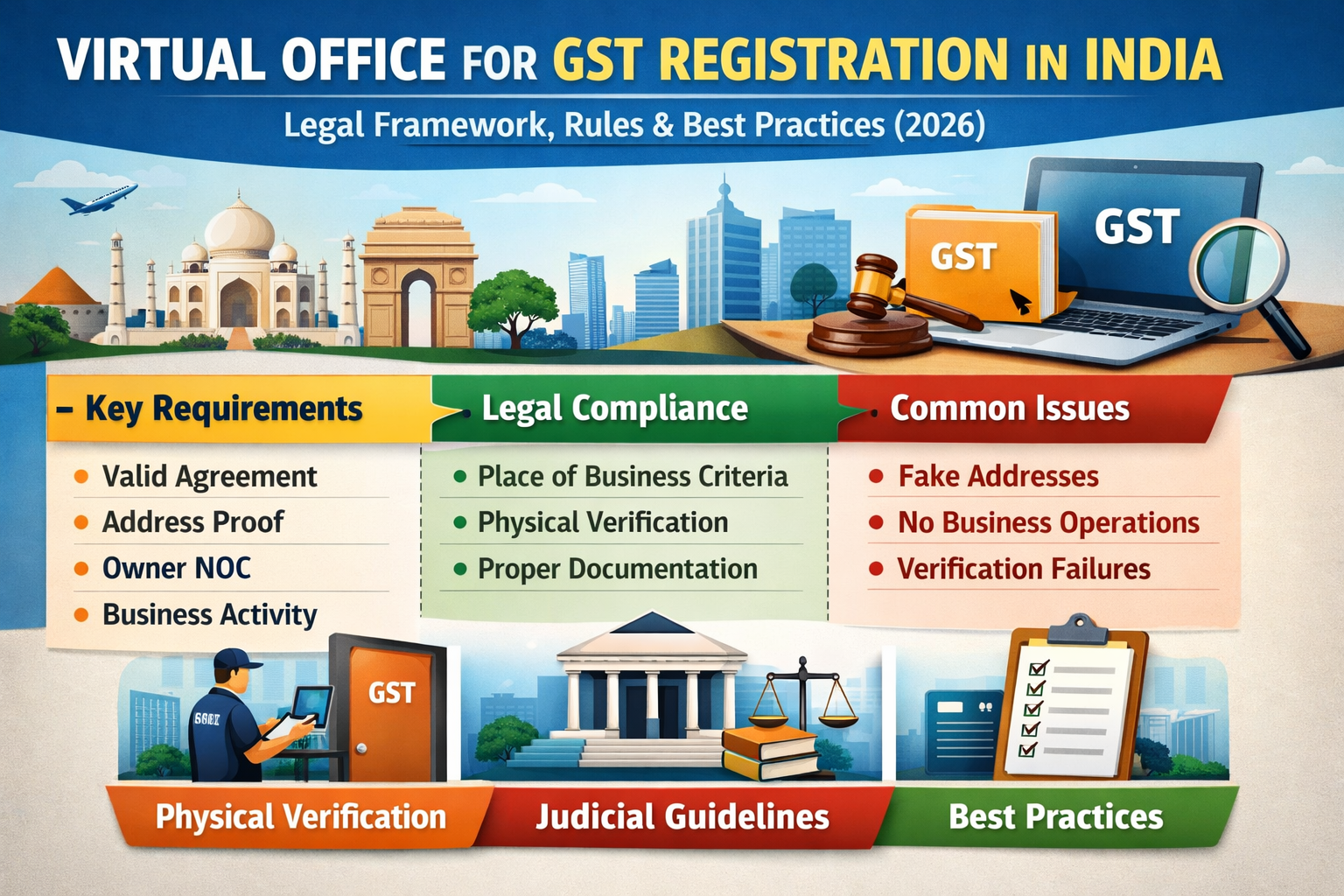
In India, the idea of a virtual office for GST registration has become quite popular. This is because more and more enterprises are doing business across state lines without having to deal with traditional brick-and-mortar offices. Startups, consultants, service providers, and businesses that are developing are using virtual office addresses to meet Goods and Services Tax (GST) standards while still being able to run their businesses well. But whether or not these kinds of deals are permissible depends entirely on obeying the GST rules, filling out the right forms, and what the courts say.
Businesses need to grasp the rules for virtual offices before they can use them to register for GST. This is because GST authorities have gotten better at scrutinizing things since 2026. This page presents a clear overview of the law, the laws that apply, the most recent requirements for compliance, and the best strategies to make sure that using a virtual office to register for GST in India is legal.
What does GST legislation say about a virtual office?
The GST Act does not include a separate category for a virtual workplace. Section 2(85) of the CGST Act, 2017, gives a broader definition of “place of business.”
A place of business is:
• A place where people frequently transact business
• A place where account records are stored
• A place where a representative or agent does their job
A virtual office for GST registration is only legal if it fits the legal definition of a business and there is proof that it is a real business.
Is it okay to utilize a virtual office to sign up for GST?
From a legal point of view, you don’t have to own property to register for GST. It says this:
• Legal ownership
• The right to use the land
• The capacity to furnish documentary evidence
Several advance orders, departmental explanations, and remarks from the High Court have made it clear that you don’t have to own something physically, but you do have to follow the rules on paper.
If you have a virtual office for GST registration, it is valid if:
• The address is real, simple to find, and simple to go to
• There is a rental or service agreement that is lawful
• The applicant can prove that they are doing business and have a business purpose
GST officers can undertake physical verification before or after providing registration, as stated in Rule 9 and Rule 25.
Rules 8 and 9 of the GST apply to using a virtual office: signing up and checking
People routinely identify GST registration applications that use virtual addresses to check if they are real. Officers check:
• How real the address is
• What kind of business activity
• Papers that support Rule 25: Going to see things in person
Authorities may visit the site if the following conditions are met:• The address doesn’t seem to be working.
• There are more than one registration at the same place
• Problems with compliance in the past are found. Under Rule 9(4), failing to verify could lead to rejection.
What You Need to Register for GST in a Virtual Office
To legally use a virtual office for GST registration, you need to have the following documents:
1. A legal contract
• Rent Agreement, License Agreement, or Service Agreement
◦ Must explicitly say that GST can be used
2. Proof of Address for the Property
◦ A receipt for your property tax or power bill
• Should not be expired or out of sync
3. The owner must give permission. A No Objection Certificate (NOC) from the owner of the property
4. Proof of Business: A statement of what kind of business it is
• Papers that support the claim, such as contracts, invoices, or a website
5. Signs and Accessibility (Recommended) It is easier to check success with a name board.
One of the main reasons why people don’t want GST in virtual office scenarios is because the agreements aren’t complete or are too vague.
Why People Often Don’t Use GST When Working from Home
It is permissible to register for GST via a virtual office, however many applications are turned down because of mistakes. Here are some common reasons:
• Address solely used as a “mailing address”
• No evident business going on
• Addresses that were shared but not properly separated
• Deals that are wrong or can’t be proven
• Failure during the verification of officers
GST officials will rely heavily on risk profiles and data analytics in 2026, thus it is vitally important that these tools are accurate and open.
The courts and the department’s point of view (up to 2026)
Indian courts have always said that GST registration can’t be denied just because the applicant doesn’t own the property. They have also made it plain that bogus or paper addresses are not acceptable.
The courts are going in the right direction:
• Substance over form
• The real skill to run a business
• Real business purpose
A virtual office for GST registration is only legal if it is utilized as a real company address and not as a proxy.
The Right Way to Use a Virtual Office for GST Registration
To make sure they stay compliant and don’t have to cancel, businesses should undertake the following:
1. Choose a Provider Who Is Verified
Pick a supplier that can help you with documentation and checking that it meets GST standards.
2. Make it easy for people to get in touch with officers
The premises should be open for verification during business hours.
3. Keep books and records
Keep digital or paper records that are linked to the address where you live.
4. Don’t let too many people in. Having too many GST registrations at one place makes things harder.
5. Always use the same address
Check that the GST, bank, MCA, and contract papers all say the same thing.
6. Respond to Notices Right Away
You need to respond to REG-03 notices with proof and accuracy.
Things to consider about after you sign up
Getting GST registration through a virtual office is only the first step. It’s really vital to keep up with compliance.
Authorities might begin:
• Checking after signing up
• Review by ITC
• Cancellation proceedings under Section 29
If you don’t follow the rules or lie, you could:
• Cancellation of GST
• Reversal of ITC
• Fees and interest
Because of this, companies should think of the virtual office as a permanent place to work, not just a quick fix.
The Future: Virtual Office and GST in 2026 and Beyond
As compliance becomes more digital and GST enforcement becomes stronger, virtual office setups will only be okay if they are clear and easy to find.
Regulators are now focusing on:
• Real economic presence
• Following the rules based on data
• Getting in touch with other departments
Businesses that use a virtual office to register for GST must put compliance first and make sure that their structure can stand up to legal and administrative examination.
Last Thoughts
As long as a virtual office fits the legal definition of a place of business and follows all the laws, paperwork standards, and verification procedures for GST, it will be allowed to register for GST in India in 2026. It’s not illegal to have a virtual office, but it’s illegal to use one the incorrect way, lie about it, or register it without a solid reason.
Companies that view virtual offices as a means of compliance rather than evasion can confidently adopt this approach for scalable and cost-effective growth under the GST framework.
