Not Just Food, but a Daily Ritual
New York Style Pizza is often described as a dish, but that definition falls short. In New York, pizza functions more like a routine—something eaten standing up, folded in half, or carried down a crowded sidewalk without ceremony. It is food designed for movement, built for a city that never pauses long enough for formality.
What makes this style remarkable is not innovation or luxury, but repetition. Millions of slices are produced daily, yet the experience remains deeply personal. Each person has a favorite shop, a preferred level of char, and a memory attached to a late-night stop or hurried lunch break.
How the City Shaped the Slice
New York Style Pizza did not emerge from culinary ambition alone. It was shaped by economics, migration, and space. Early pizzerias needed to feed large numbers of people quickly and affordably. The result was a pizza that was wide, thin, and efficient.
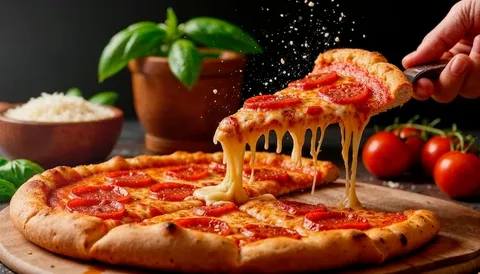
The large diameter allowed a single pie to be cut into generous slices, while the thin base reduced cooking time. High heat ovens produced a crust that was crisp underneath yet flexible enough to fold. This balance was not accidental; it was a response to the pace and density of the city itself.
See more: Best New York Style Pizza
The Dough: Simplicity with Precision
The foundation of New York Style Pizza lies in its dough, which appears simple but demands control. Made with basic ingredients—flour, water, yeast, and salt—the dough relies on fermentation time rather than additives for flavor.
What separates this dough from others is elasticity. It stretches easily without tearing and bakes into a structure that supports toppings without becoming heavy. The finished crust is thin at the center, slightly thicker at the edge, and strong enough to be held with one hand.
This balance is critical. Too soft, and the slice collapses. Too crisp, and it loses its defining fold.
Sauce and Cheese: Restraint Over Excess
Unlike heavily layered pizzas, New York Style Pizza uses restraint. The sauce is applied sparingly, allowing the flavor of tomatoes to remain present without overwhelming the base. It is cooked just enough to remove raw acidity while preserving freshness.
Cheese follows the same principle. Low-moisture mozzarella is distributed evenly, melting into a uniform layer rather than pooling in excess. The goal is cohesion—each bite delivering bread, sauce, and cheese in equal measure.
This measured approach ensures consistency across slices, even when eaten hours apart.
The Slice Economy
One unique aspect of New York Style Pizza is how it is sold. While whole pies exist, the culture revolves around individual slices. This changes how the pizza is prepared and stored.
Slices must reheat well without drying out or becoming rubbery. The crust must regain crispness, and the cheese must melt again without separating. These requirements influence everything from ingredient selection to oven temperature.
In this way, the slice itself becomes a product designed for repeat handling and quick service.
Cultural Identity on a Paper Plate
New York Style Pizza transcends cuisine and enters identity. It appears in movies, television, and everyday conversation as shorthand for the city itself. Tourists seek it out, locals debate its best versions, and newcomers use it as a benchmark for belonging.
The pizza does not change dramatically from neighborhood to neighborhood, yet subtle differences matter deeply to those who notice. These variations create loyalty, debate, and tradition—hallmarks of any lasting cultural symbol.
Why It Endures Without Reinvention
Many food trends rely on novelty to survive. New York Style Pizza does the opposite. It remains relevant by refusing to reinvent itself unnecessarily. Its endurance comes from reliability, not surprise.
In a world of experimental toppings and evolving food aesthetics, this pizza holds its ground by delivering exactly what is expected—every time. That predictability is not a weakness; it is the reason the style has spread globally without losing its identity.
Conclusion: A City You Can Taste
New York Style Pizza is not defined by a recipe alone. It is defined by context—by sidewalks, subway rides, late nights, and fast conversations. It reflects a city built on movement, diversity, and efficiency.
More than a meal, it is a shared experience repeated millions of times, unchanged because it does not need to be. In every folded slice, there is a small, edible version of New York itself.
For more information: click here