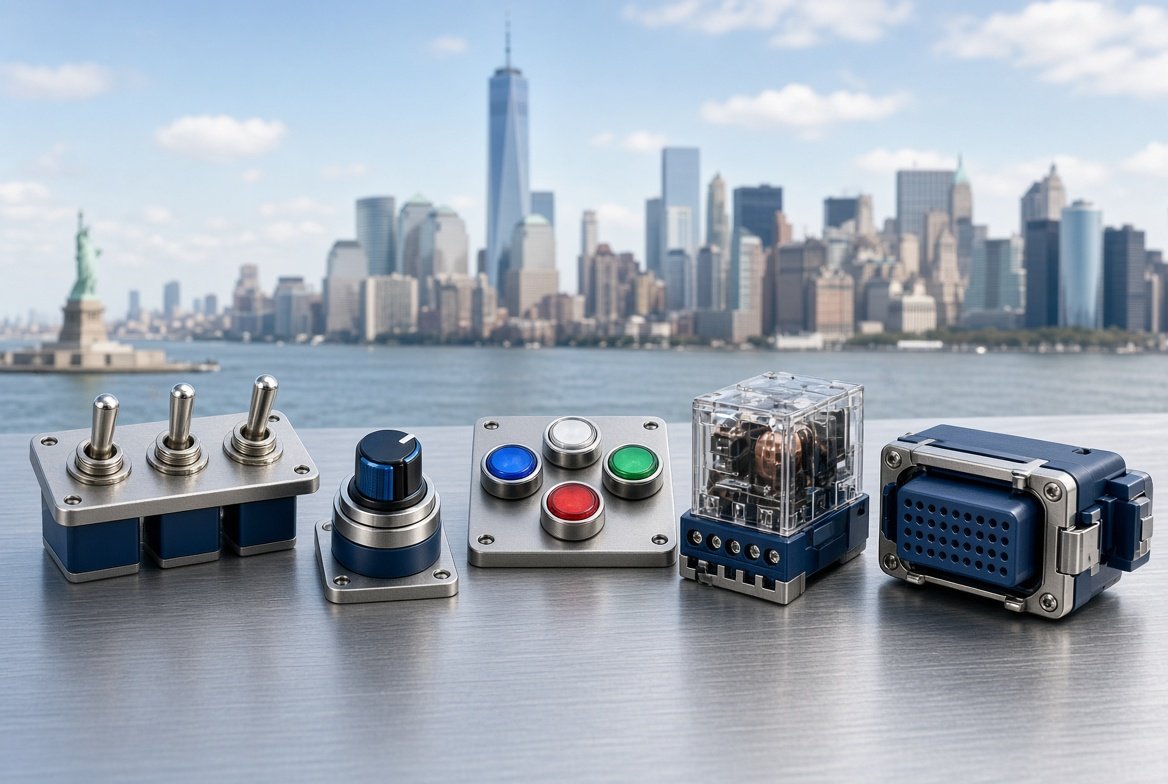
Electromechanical switches form a critical foundation in countless industrial, commercial, and specialized systems across New York’s diverse economy. These components bridge the gap between mechanical action and electrical control, enabling precise operation in everything from manufacturing lines and transportation infrastructure to medical equipment and building automation.
For professionals working in engineering, maintenance, design, and procurement roles throughout the state, selecting and sourcing the right electromechanical switches demands careful attention to performance, durability, and long-term availability. New York’s dense concentration of manufacturing facilities, research institutions, transportation networks, and high-tech industries creates sustained demand for switches that can withstand rigorous conditions while delivering consistent reliability.
Understanding the Core Function of Electromechanical Switches
At their essence, electromechanical switches convert physical movement into electrical signals or circuit changes. Unlike purely electronic solid-state alternatives, these devices rely on moving parts such as contacts, springs, actuators, and levers to open or close circuits. This mechanical action provides distinct advantages in applications requiring tactile feedback, high current handling, or isolation between control and power circuits.
Professionals in New York frequently encounter variants including toggle switches, push-button switches, rocker switches, rotary switches, limit switches, micro switches, and snap-action switches. Each type serves specific operational needs. Toggle switches offer straightforward on-off or multi-position control, while limit switches detect the presence or position of moving machinery components. Micro switches deliver precise actuation with minimal force, making them valuable in safety interlocks and precision instruments.
The electromechanical design allows these switches to handle higher voltages and currents than many semiconductor-based options, and they often operate effectively across wide temperature ranges. In New York’s varied climate, from humid coastal conditions in the metropolitan area to colder inland environments, thermal stability and resistance to environmental factors become essential selection criteria. Professionals must also consider contact materials, sealing ratings, and mechanical life cycles when specifying switches for long-term installations.
Applications Driving Demand Across New York Industries
New York’s industrial landscape places unique demands on electromechanical switch technology. In manufacturing plants concentrated in areas such as Long Island, the Hudson Valley, and western regions of the state, these switches control conveyor systems, robotic arms, packaging equipment, and process machinery.
Limit switches and proximity-related electromechanical devices ensure safe operation by detecting end-of-travel positions and preventing collisions. In the transportation sector, including rail, aviation support, and elevators, switches play roles in door interlocks, control panels, and safety systems that protect both operators and the public.
Building automation and commercial facilities throughout New York City and surrounding boroughs rely on electromechanical switches for lighting control, HVAC systems, access management, and emergency circuits. Medical device manufacturers and research laboratories require switches that meet stringent cleanliness, reliability, and regulatory standards. Even in renewable energy installations and data centers emerging across the state, electromechanical components continue to provide robust control solutions where pure electronic alternatives may fall short under certain electrical or environmental stresses.
Professionals responsible for system design or maintenance understand that switch failure can lead to costly downtime, safety risks, or production interruptions. Therefore, factors such as actuation force, contact bounce, electrical rating, and expected cycle life receive careful evaluation during the selection process. Many projects also require switches that comply with specific industry standards, including those related to industrial safety, hazardous locations, or medical device regulations.
Key Considerations for Selecting Electromechanical Switches
When professionals evaluate electromechanical switches for New York-based projects, several technical parameters guide decision-making. Electrical ratings must match or exceed the circuit requirements for voltage, current, and power. Mechanical life expectancy, often measured in millions of cycles, determines suitability for high-frequency applications. Environmental protection ratings, such as IP classifications for dust and moisture resistance, prove particularly important in industrial settings or outdoor installations common in infrastructure projects.
Actuator style influences both user interaction and integration into machinery. Lever actuators, roller levers, pushbuttons, and rotary mechanisms each offer distinct advantages depending on the required motion detection or operator interface. Contact configuration—normally open, normally closed, or changeover—must align with the control logic of the overall system. Material choices for housings and contacts affect corrosion resistance and electrical performance over time, especially in environments exposed to chemicals, humidity, or temperature extremes.
Supply chain reliability has grown increasingly critical. Professionals often face challenges related to component obsolescence, extended lead times, and allocation issues for specialized or older-generation switches. Maintaining access to both current production parts and hard-to-find legacy components helps ensure continuity for existing equipment that may remain in service for decades. Quality documentation, traceability, and counterfeit prevention measures further protect against risks in critical applications.
The Role of Specialized Distribution in Supporting Professionals
Access to a dependable source of electromechanical switches and related components remains essential for New York professionals managing complex projects or ongoing maintenance programs. Specialized distributors that maintain substantial inventory, offer obsolescence management services, and provide technical support help bridge the gap between global manufacturers and local end users.
One such provider, Vantage Components, operates from its New York headquarters and supports OEMs, contract manufacturers, and repair facilities with electromechanical devices alongside semiconductors, interconnect products, and other critical parts. Their focus on stocking, asset management, and securing allocated or end-of-life material addresses many of the practical challenges professionals encounter when keeping systems operational.
Beyond simple availability, knowledgeable distribution partners can assist with cross-referencing, identifying suitable alternatives when original parts become unavailable, and ensuring components meet required specifications. This support proves especially valuable in New York’s fast-paced industrial environment, where project timelines and equipment uptime carry significant financial implications.
Emerging Trends and Future Outlook
While solid-state and smart switching technologies continue to advance, electromechanical switches retain strong relevance due to their inherent simplicity, robustness, and cost-effectiveness in many applications. Hybrid approaches that combine mechanical durability with electronic monitoring or connectivity are appearing in newer designs. Professionals increasingly seek switches that offer diagnostic capabilities or integration with industrial Internet of Things platforms while preserving the core mechanical reliability that has proven effective for generations.
Sustainability considerations also influence selection. Longer-life components reduce replacement frequency and waste, while energy-efficient designs contribute to overall system performance. As New York continues investing in infrastructure modernization, advanced manufacturing, and clean energy initiatives, demand for high-quality electromechanical switches is expected to remain steady.
Professionals who stay informed about both traditional and evolving switch technologies will be better positioned to specify solutions that balance performance, longevity, and total cost of ownership.