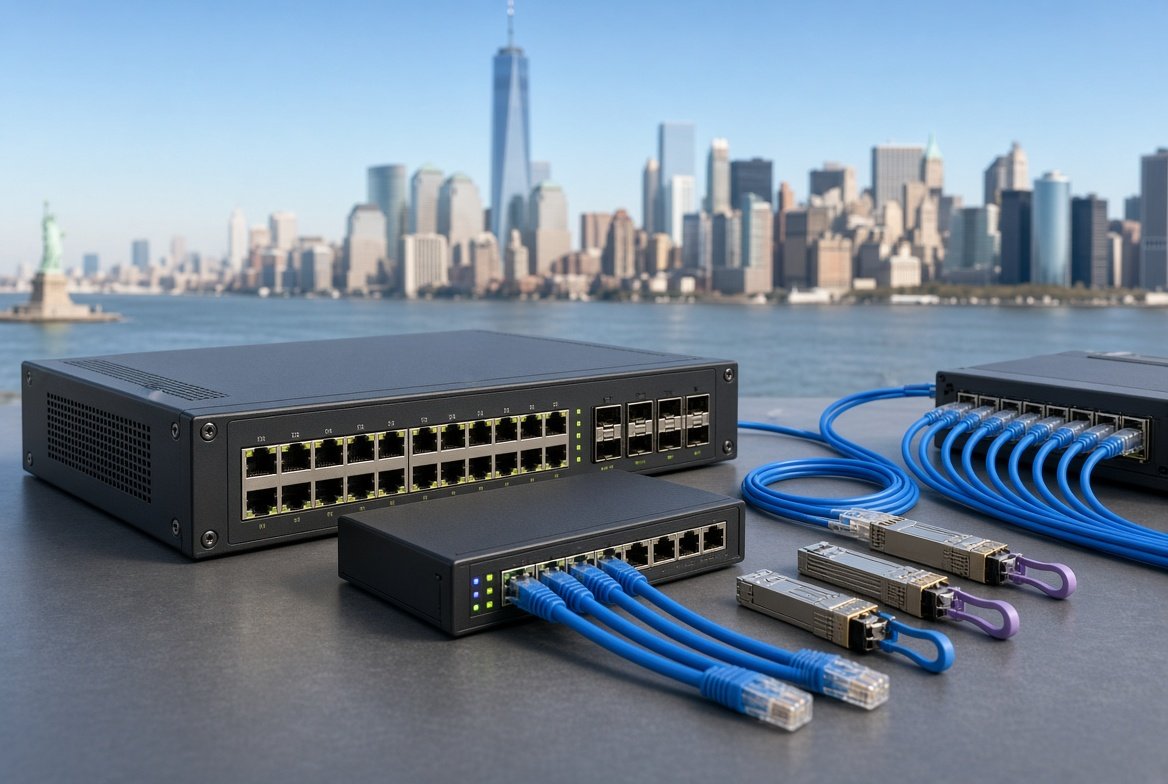
In the dynamic landscape of New York City and the broader state, data networking equipment forms the backbone of seamless digital operations for businesses, institutions, and data centers. From Wall Street financial firms requiring ultra-low latency connections to tech startups in Brooklyn and healthcare providers across the five boroughs, the demand for robust networking hardware continues to grow.
Data networking equipment encompasses a wide range of devices designed to facilitate the transmission, routing, switching, and security of data packets across local area networks, wide area networks, and cloud-connected infrastructures. In a region known for its dense concentration of enterprises and high-stakes digital environments, selecting the right equipment is not merely a technical decision but a strategic one that impacts uptime, scalability, and competitive advantage.
New York’s unique urban density and concentration of industries create specific requirements for networking infrastructure. High-rise buildings in Manhattan often demand specialized cabling and wireless solutions that overcome signal interference, while data centers in locations such as Secaucus and other nearby hubs require high-performance switches and routers capable of handling massive traffic volumes.
The state’s position as a global financial and media capital means that network reliability is non-negotiable; even brief interruptions can result in significant financial losses or reputational damage. Consequently, organizations invest in enterprise-grade equipment that supports advanced protocols, high throughput, and redundancy features tailored to the demands of continuous operations.
Core Components of Data Networking Infrastructure
At the heart of any effective network lie several categories of equipment that work in concert. Routers serve as the primary devices for directing traffic between different networks, determining the optimal path for data packets based on destination addresses and network conditions. In New York environments, where hybrid cloud architectures are common, routers must support advanced features such as multiprotocol label switching and secure VPN capabilities to connect on-premises systems with remote cloud resources efficiently.
Switches, operating primarily at the data link layer, enable devices within the same network to communicate by forwarding frames based on MAC addresses. Modern managed switches offer features like VLANs, quality of service prioritization, and power over Ethernet, which prove especially useful in office spaces and conference facilities throughout the city where VoIP phones, cameras, and access points share the same infrastructure.
Firewalls and security appliances represent another critical layer. Given the sophisticated threat landscape facing New York-based organizations in finance, government, and media, next-generation firewalls that combine traditional packet filtering with intrusion
n prevention, application awareness, and encrypted traffic inspection have become standard. Wireless access points and controllers complete the picture for many deployments, supporting the dense device populations found in co-working spaces, universities, and retail locations. High-density Wi-Fi solutions that handle hundreds of concurrent connections while maintaining performance are particularly valued in venues such as Madison Square Garden events or corporate campuses in Midtown.
Factors Influencing Equipment Selection in the New York Market
Choosing appropriate data networking equipment requires careful consideration of several interrelated factors. Bandwidth requirements must align with current and projected traffic patterns; a financial trading firm may prioritize low-latency switches and routers, while a media production company might focus on high-capacity storage area network connectivity. Scalability remains essential because New York businesses frequently expand or reconfigure office spaces, and equipment that supports modular growth reduces the need for wholesale replacements.
Compatibility with existing infrastructure, including legacy systems still present in many older buildings, also plays a significant role. Energy efficiency has gained importance as organizations seek to control operational costs and meet sustainability goals, making equipment with efficient power supplies and intelligent power management attractive.
Environmental conditions unique to New York further influence decisions. Equipment installed in data center cages or rooftop telecom rooms must tolerate temperature fluctuations and potential humidity variations. Physical security considerations, including lockable chassis and secure management interfaces, protect against unauthorized access in shared facilities.
Compliance with industry standards and regulations, such as those governing financial data handling or healthcare information, often dictates the inclusion of specific encryption and logging capabilities. Organizations that partner with experienced providers gain access to curated selections of equipment that meet these multifaceted criteria while receiving guidance on optimal configurations.
Deployment and Maintenance Considerations
Successful implementation of data networking equipment extends beyond the initial purchase. Proper site surveys identify potential interference sources, cabling pathways, and power availability, particularly important in the complex architecture of New York buildings. Professional installation ensures correct configuration of routing protocols, security policies, and redundancy mechanisms such as hot-swappable power supplies and stacked switch configurations. Ongoing monitoring through network management systems allows administrators to track performance metrics, detect anomalies, and plan capacity upgrades before bottlenecks occur.
Maintenance strategies typically combine remote diagnostics with scheduled on-site visits. Firmware updates, security patches, and proactive component replacements minimize the risk of unexpected failures. In a city where skilled technical talent is both abundant and competitive, many organizations rely on external partners for specialized expertise rather than maintaining large in-house teams.
Training for internal staff on the specific equipment in use further enhances operational resilience. Lifecycle management, including eventual decommissioning and responsible recycling of older hardware, aligns with environmental regulations and corporate responsibility initiatives prevalent among New York enterprises.
Emerging Trends Shaping Networking Equipment Needs
The evolution of networking technology continues to reshape requirements across New York. Software-defined networking and intent-based networking allow greater automation and policy-driven control, reducing the manual configuration burden on IT teams. The growth of edge computing, driven by applications in autonomous systems, real-time analytics, and content delivery, places new demands on local networking gear that must process data closer to the source.
Artificial intelligence integration into network management tools promises predictive maintenance and dynamic optimization of traffic flows. Meanwhile, the ongoing transition to higher-speed Ethernet standards and Wi-Fi 6E and Wi-Fi 7 technologies supports the increasing volume of data generated by IoT devices, video collaboration platforms, and immersive applications.
Cloud-native architectures and hybrid environments require networking equipment that bridges traditional on-premises networks with multi-cloud connectivity seamlessly. Zero-trust security models influence the design of access control and micro-segmentation features built into modern switches and firewalls. As remote and hybrid work patterns persist, secure remote access solutions and robust campus wireless networks remain priorities. Organizations that stay informed about these trends position themselves to adopt equipment capable of supporting future applications without frequent disruptive upgrades.