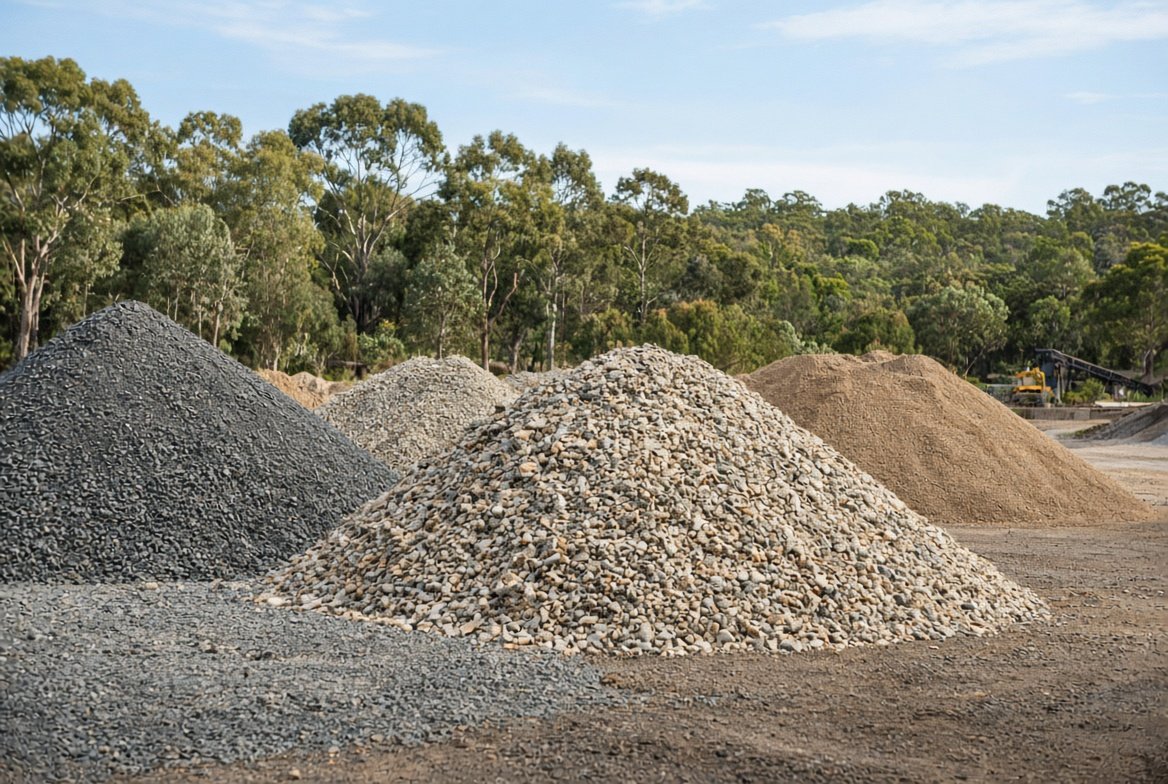
Recycled road base has become an essential material in the construction and civil infrastructure sector across Victoria, Australia. Produced primarily from crushed concrete, brick, masonry, and reclaimed asphalt pavement recovered from demolition and construction sites, this engineered aggregate delivers reliable performance while supporting the state’s circular economy goals. As traditional quarry resources face increasing pressure from urban expansion and environmental constraints, recycled road base offers a practical, high-performing alternative that meets rigorous engineering standards and helps divert substantial volumes of waste from landfill.
What Is Recycled Road Base and How Is It Produced
Recycled road base is created through a controlled process of sorting, crushing, screening, and grading construction and demolition waste. Contaminants such as timber, plastics, and metals are carefully removed, after which the remaining concrete, brick, and asphalt are processed into consistent particle size distributions suitable for pavement layers. In Victoria, the material is typically supplied as Class 2, Class 3, or Class 4 crushed concrete or blended products that align with Department of Transport and Planning specifications. These products can be further modified through cement or lime stabilisation when additional strength is required. The resulting material exhibits excellent compaction characteristics, good interlocking properties, and adequate drainage, making it comparable in many applications to virgin crushed rock sourced from quarries.
The production process itself contributes to lower embodied carbon compared with extracting and transporting new aggregates. Local processing facilities across Melbourne and regional Victoria reduce haulage distances, further cutting emissions associated with material delivery. VicRoads technical guidance recognises that when recycled products meet the relevant grading, plasticity, strength, and contamination limits, they can be considered equivalent to traditional quarry materials for designated pavement layers.
Benefits of Recycled Road Base in Victorian Projects
One of the primary advantages of recycled road base lies in its environmental contribution. Victoria generates millions of tonnes of construction and demolition waste annually. Converting a significant portion of this stream into road pavement materials reduces pressure on landfill capacity and preserves finite natural rock resources for applications where substitution is not yet feasible. Studies and field experience within the state have demonstrated that properly processed recycled crushed concrete can achieve California Bearing Ratio values and resilient modulus results that support its use in base and subbase layers under a wide range of traffic loadings.
From a performance perspective, recycled road base often displays beneficial self-cementing properties due to residual unhydrated cement particles within the crushed concrete. Over time this can lead to increased stiffness in the pavement layer, enhancing load distribution and potentially extending service life under certain conditions. The material also tends to be lighter in bulk density than some virgin aggregates, which can translate into lower transport costs and easier handling on site. For residential driveways, commercial hardstands, and lower-trafficked local roads, these characteristics combine to deliver a cost-effective solution without compromising structural integrity.
Economic considerations further strengthen the case for adoption. As the supply of high-quality metropolitan quarry materials becomes constrained, recycled alternatives frequently offer competitive pricing. Reduced cartage from distant regional quarries also lowers overall project costs, particularly for metropolitan and outer-suburban works. Victorian government initiatives, including the Recycled First policy applied to major transport projects, continue to stimulate demand and encourage consistent quality standards across the supply chain.
Compliance with Victorian Standards and Specifications
Successful use of recycled road base in Victoria depends on adherence to established technical requirements. The Department of Transport and Planning maintains a framework through Code of Practice RC 500.02 for the registration of crushed rock mixes, along with Standard Specification Sections 812, 813, and 815 that govern production and placement of base and subbase materials. Technical Note TN 107 provides detailed guidance on the allowable proportions of recycled crushed concrete and supplementary materials such as crushed brick or glass fines in different pavement layers.
Class 3 and Class 4 products may incorporate high percentages of recycled concrete, while Class 2 materials are subject to stricter limits on supplementary content depending on the design traffic loading. Lower Trafficked Base and Lower Trafficked Subbase categories under Section 813 allow specific recycled content suited to roads carrying lower average annual daily traffic. Materials intended for use must also satisfy environmental classification requirements administered by the Environment Protection Authority Victoria, ensuring contaminant levels remain within acceptable thresholds for the intended application. Independent laboratory testing, often NATA-accredited, verifies grading, Atterberg limits, Los Angeles abrasion resistance, and California Bearing Ratio performance before material is released for supply.
Common Applications Across Victoria
Recycled road base finds widespread use throughout the state. In residential settings it forms the compacted subbase under concrete or asphalt driveways, providing a stable platform that resists settlement and supports vehicle loads. Commercial and industrial projects employ it for car parks, hardstand areas, and under-slab preparation. Local government road rehabilitation and subdivision works frequently specify Class 3 or Class 4 recycled products for subbase layers, while higher-specification Class 2 material may be selected for upper base courses on more heavily trafficked routes.
Additional applications include trench backfill around utilities, bedding for kerbs and channels, and temporary access roads during construction. The versatility of the material allows engineers and contractors to match product class to specific design requirements, optimising both performance and resource efficiency. Major infrastructure projects under Victoria’s Big Build program have demonstrated successful large-scale incorporation of recycled content in road pavements, further validating its reliability when correctly specified and installed.
Environmental and Economic Advantages for Sustainable Development
The broader sustainability benefits of recycled road base align closely with Victorian government objectives around resource recovery and emissions reduction. By keeping construction materials in productive use rather than disposing of them, the industry supports a circular economy model that reduces virgin material extraction and associated land disturbance. Lower processing energy requirements compared with quarrying contribute to reduced greenhouse gas emissions across the supply chain. Over the life of a pavement, the potential for improved durability in certain recycled mixes can also decrease the frequency of maintenance interventions, delivering whole-of-life cost savings.
Local production facilities create employment opportunities in material recovery and processing while reducing the carbon intensity of long-distance aggregate haulage. For project owners seeking to demonstrate environmental credentials, the documented use of recycled road base provides measurable outcomes in waste diversion and resource conservation that can be reported against sustainability frameworks.
Selecting and Using Quality Recycled Road Base
When specifying recycled road base, attention should be given to the source facility’s registration status, recent test certificates, and consistency of production. Moisture content at delivery influences compaction behaviour, so field density testing remains essential to achieve design targets. Proper placement techniques, including appropriate layer thickness and compaction plant, ensure the material reaches its full structural potential. In many cases the material can be supplied as a wet mix to improve workability and dust control during placement.
For projects ranging from private driveways to municipal road upgrades, recycled road base offers a proven combination of performance, affordability, and environmental responsibility. Building and Garden Supplies provides high-quality recycled road base products that meet Victorian specifications and support sustainable construction outcomes across the state.
FAQs
What is the difference between recycled road base and virgin crushed rock?
Recycled road base is manufactured from processed construction and demolition materials such as concrete and brick, while virgin crushed rock is extracted from natural quarry sources.
Is recycled road base suitable for high-traffic roads in Victoria?
Yes, under appropriate design conditions. Class 2 and certain stabilised Class 3 materials are permitted in higher-trafficked applications when they meet the required engineering properties.
Does recycled road base meet environmental regulations in Victoria?
Materials must be classified in accordance with Environment Protection Authority Victoria requirements and free from unacceptable levels of contaminants. Reputable suppliers provide documentation confirming that products are suitable for the intended use and comply with both environmental and engineering standards.
How does the cost of recycled road base compare with traditional materials?
Recycled road base is generally more cost-competitive because it utilises existing materials and often involves shorter transport distances. Price variations occur depending on product class, moisture content, delivery location, and current market conditions, but overall project savings are commonly realised through reduced material and cartage expenses.
Can recycled road base be used under concrete slabs and for driveway construction?
Yes. It is widely used as a compacted subbase beneath concrete slabs, residential driveways, and paved areas. Proper compaction to the specified density ensures a stable foundation that minimises settlement and supports the surface layer effectively.