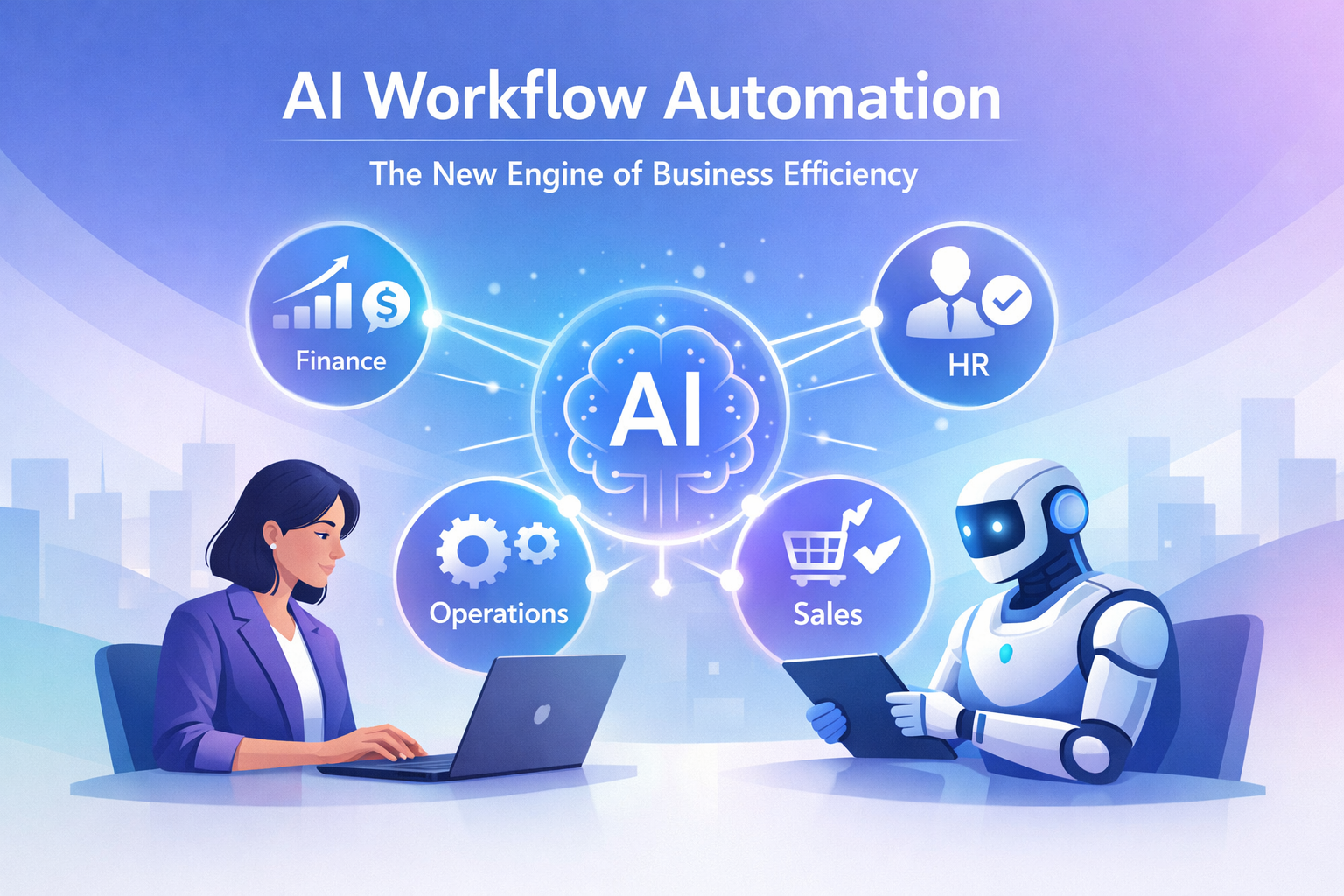
AI workflow automation isn’t just another tech buzzword anymore. In 2026, it’s quietly becoming the backbone of how efficient companies operate deciding faster, scaling smarter, and freeing humans from work that never needed a human in the first place.
If you’ve ever felt that your business tools don’t talk to each other, approvals take too long, or teams spend more time managing processes than doing meaningful work, this article is for you.
Let’s break down how AI workflow automation is reshaping business efficiency in 2026, what’s different from earlier automation waves, and how forward-thinking companies are using agentic AI to gain a serious competitive edge.
What Is AI Workflow Automation (And Why 2026 Is a Turning Point)?
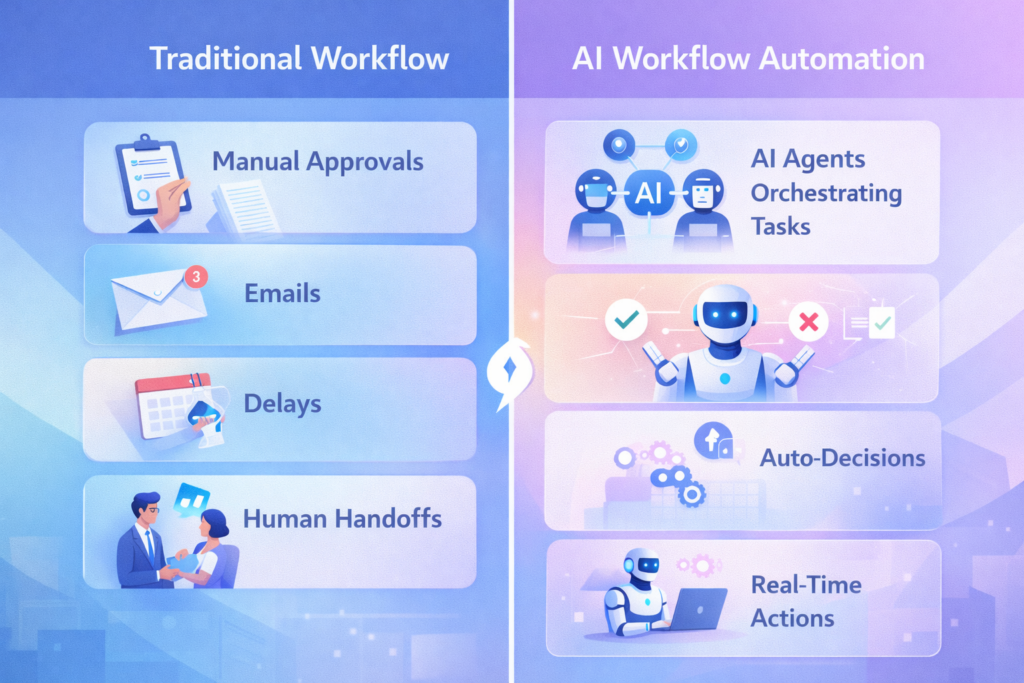
At its core, AI workflow automation uses artificial intelligence to design, manage, and optimize business processes end-to-end with minimal human intervention.
Unlike traditional automation (which follows rigid rules), AI-powered workflows can:
- Learn from data
- Adapt to changing conditions
- Make context-aware decisions
- Improve performance over time
What changed in 2026?
Three big shifts made AI workflow automation mainstream:
- Agentic AI maturity – AI systems can now plan, act, evaluate outcomes, and self-correct.
- Enterprise-ready AI platforms – Scalable, secure, and compliant enough for real businesses.
- Process complexity overload – Human-led workflows simply can’t keep up anymore.
This is why enterprise AI automation is no longer optional, it’s strategic.
How AI Workflow Automation Boosts Business Efficiency
Let’s get practical. Here’s how companies are seeing real efficiency gains.
1. Eliminating Manual Bottlenecks Across Teams
Every business has hidden time drains:
- Approval delays
- Data handoffs between tools
- Repetitive follow-ups
- Human errors in routine tasks
AI workflow automation removes these bottlenecks by orchestrating tasks across systems automatically.
Example:
An AI workflow can:
- Detect a new sales lead
- Enrich it with CRM and external data
- Assign it to the best-fit rep
- Trigger personalized outreach
- Notify finance if deal size crosses a threshold
All without manual coordination.
Result: Faster execution, fewer errors, happier teams.
2. From Rule-Based Automation to Agentic AI Decision-Making
Traditional automation follows if-this-then-that logic. In contrast, agentic AI workflows operate with intent.
They can:
- Decide which action to take
- Prioritize tasks dynamically
- Adjust workflows when conditions change
This is a major leap in efficiency.
Why it matters:
Instead of stopping when something unexpected happens, agentic AI adapts, just like a human would, but faster.
This is the foundation of modern enterprise AI automation.
3. Smarter Finance Operations With Agentic AI
One of the most impactful use cases is agentic AI in finance.
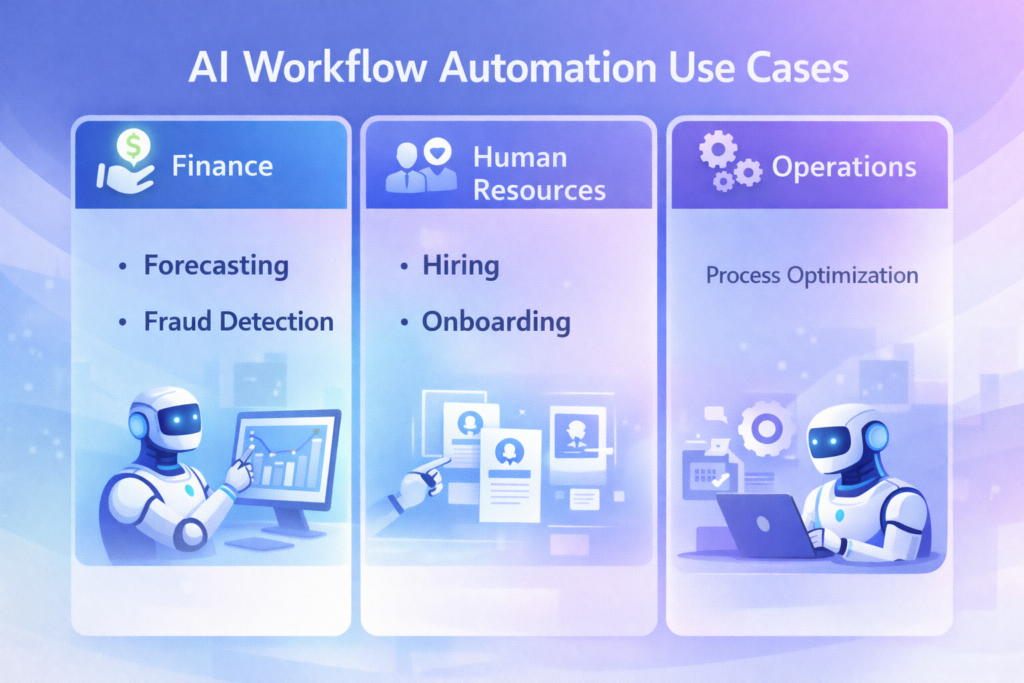
Finance teams in 2026 are using AI workflows to automate:
- Invoice processing and validation
- Fraud detection and anomaly monitoring
- Budget forecasting and variance analysis
- Compliance reporting
Real-world impact:
An AI workflow can flag suspicious transactions before they’re processed, request clarification automatically, and escalate only when necessary.
Efficiency gain:
- Faster month-end closes
- Reduced compliance risk
- Less manual reconciliation
Finance leaders are no longer buried in spreadsheets, they’re focused on strategy.
4. Transforming HR With Intelligent Workflows
HR has quietly become one of the biggest beneficiaries of AI workflow automation.
Agentic AI in human resources enables:
- Automated resume screening based on evolving criteria
- Interview scheduling across time zones
- Personalized onboarding workflows
- Continuous employee engagement analysis
Instead of rigid hiring funnels, AI workflows adapt based on candidate quality, role urgency, and team feedback.
Outcome:
- Shorter hiring cycles
- Better candidate experience
- Reduced HR burnout
5. Always-On Process Optimization (Without Consultants)
In the past, improving efficiency meant:
- Hiring consultants
- Running audits
- Redesigning processes manually
In 2026, AI workflow automation optimizes itself.
Agentic systems:
- Monitor workflow performance
- Identify delays or inefficiencies
- Suggest or apply improvements automatically
Think of it as a self-improving operations layer for your business.
This is one of the most underrated benefits of enterprise AI automation.
6. Scaling Operations Without Scaling Headcount
Growth used to mean more people, more managers, more complexity.
AI workflow automation flips that equation.
With AI workflows, businesses can:
- Handle 2x–5x more volume
- Maintain consistency and quality
- Avoid coordination chaos
A customer support team, for example, can use AI workflows to:
- Classify tickets
- Resolve common issues instantly
- Route complex cases to the right expert
Efficiency isn’t about working harder, it’s about removing unnecessary work.
7. Cross-Department Collaboration Finally Works
One of the biggest efficiency killers is siloed teams.
AI workflow automation acts as a shared intelligence layer across departments:
- Sales → Finance
- HR → IT
- Operations → Customer Success
Instead of emails and meetings, workflows trigger actions automatically based on shared data and goals.
This is especially powerful when implemented through agentic AI solutions, like those offered by platforms such as SoftProdigy’s Agentic AI Solutions, which focus on orchestrating intelligence across the enterprise.
Common Mistakes Companies Make With AI Workflow Automation
To get the efficiency gains promised, companies must avoid these traps:
Automating broken processes
AI won’t fix bad workflows, it will just execute them faster.
Treating AI like simple software
Agentic systems need feedback loops, governance, and human oversight.
Ignoring change management
Efficiency gains fail if teams don’t trust or adopt AI workflows.
The most successful companies start small, measure impact, and scale intentionally.
How to Start Using AI Workflow Automation in 2026
If you’re wondering where to begin, here’s a simple roadmap:
Step 1: Identify high-friction workflows
Look for processes with:
- Repetition
- Delays
- High error rates
Step 2: Choose agentic-ready platforms
Not all automation tools are built for adaptive AI. Prioritize enterprise AI automation platforms that support decision-making, not just task execution.
Step 3: Keep humans in the loop
AI should augment not replace, human judgment.
Step 4: Measure efficiency continuously
Track:
- Time saved
- Cost reduction
- Process accuracy
Efficiency is a moving target, AI helps you keep up.
What Business Efficiency Will Look Like by the End of 2026
By the end of 2026, efficient businesses will look very different:
- Fewer internal emails
- Faster decisions
- Leaner teams doing higher-value work
- AI workflows handling complexity in the background
AI workflow automation won’t replace people, it will replace friction.
And the companies that embrace this shift early will operate at a speed and clarity others simply can’t match.
Final Thoughts
AI workflow automation is no longer a future trend, it’s a present-day advantage.
Whether it’s agentic AI in finance, agentic AI in human resources, or full-scale enterprise AI automation, the message is clear:
The most efficient businesses in 2026 won’t be the biggest, they’ll be the smartest.
If you’re exploring how agentic AI can transform your workflows, platforms like SoftProdigy’s Agentic AI Solutions are worth paying attention to as this space evolves.
If you found this helpful, follow for more insights on AI, automation, and the future of work.